
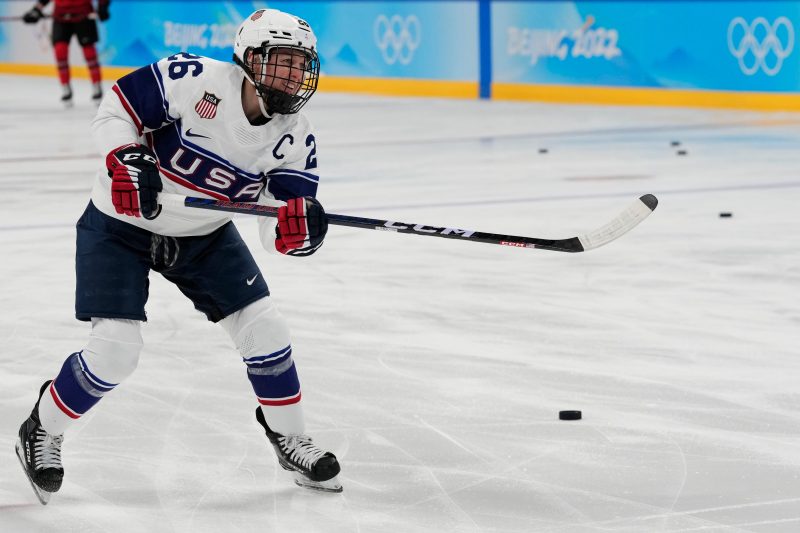
CLEVELAND – Talk to any girl or woman who’s played hockey, and she’ll have a story about trying to make her equipment fit because the gear has always been made with a male body in mind.
Kendall Coyne Schofield would use a hair tie to cinch a jersey she’d otherwise swim in. Taylor Heise would cut out pieces of her shoulder pads so they wouldn’t pop out from beneath her jersey when she got hit. Even as an adult, two-time Canadian Olympic gold medalist Catherine Ward would use gear made for boys.
And don’t even start on the yards and yards of tape every player has used trying to make her elbow pads or shin guards fit. Or kind of, sort of fit.
“This has been my whole life,” said Coyne Schofield, an Olympic gold medalist and seven-time world champion with the U.S. women. “No one’s ever asked or cared to develop gear that actually fits the woman’s body, that fits the woman’s anatomy, whether it comes to the shoulder pads, the shin guards, the hockey skates.”
Until now.
CCM this year released JetSpeed FTW, the first head-to-toe equipment line made specifically for women. Helmets, pads, pants, skates, gloves, even sticks — all designed with input from female players and scientific data about what would best fit their bodies while offering appropriate protection.
“When this FTW stuff came out, I was a little skeptical. You’ve had people that are like, `Oh, here, this is made for you.’ And you’re like, `It’s most definitely not.’ But this stuff is,” said Heise, a two-time world champion with the U.S. women and MVP of the 2022 world championships.
“It’s been very exciting to be a part of.”
Hockey tends to be more conservative than, say, basketball or soccer and, let’s be honest, is viewed through a men’s lens. Creating gear for women wasn’t thought of because why would they? Why should women need something different than what works just fine for boys and men?
But women’s bodies are built differently. Elbow and shin pads made for male players are way too big for women’s smaller frames. Same for gloves. Skates are never a good fit because a woman’s heel is narrower and her arches often higher.
Even pants. Besides men’s pants being bulkier and shapeless, female players often hike their pants up, which means the spine protector ends up being higher than where it should be to protect the lower back.
“Even when it’s the right amount of protection, it’s where it sits. If it’s not sitting in the right spot, even on the shoulder pad, there’s risk of injuries,” said Ward, now vice president of product innovation and commercialization at CCM.
“The game is evolving a lot, getting more physical. It just made a lot of sense from all the aspects that we were looking at,” Ward added. “Not just fit, but making sure that it allows for the right protection, prevent injury, comfort level. So really performing at their best.”
Natural evolution with more women playing
The argument against making equipment specifically for women used to be the return on investment. Would there be a big enough market to justify the research and development? But women’s hockey is growing — and at a faster pace than among men.
According to USA Hockey, 98,394 girls and women played hockey in 2024-25, a 5.11% increase from the previous year. The increase of boys and men playing was less than 2%. Over the last 10 years, the participation rate for girls and women increased by a whopping 36% while male participation increased by a little over 2%.
That growth figures to continue with the PWHL, now in its third season.
“There’s a lot more boys and men who play hockey than women,’ said Audrey Malka, who leads the FTW line as a business unit manager at CCM. ‘But I think especially now, when you look at the registration numbers and the women’s game is growing significantly faster than the boys game, there is a lot of just needing to be able to have (gender-specific equipment) available.”
CCM began developing female-specific products around 2017, starting with pants and shoulder pads. But about five years ago, when it came time to update those pieces, CCM decided to see if the line should be expanded.
The company did not want to simply “shrink it and pink it,” which is what too often happens when there’s a call for gear for women. Instead, it started with a global survey, asking players of all ages and levels about every piece of their gear. What worked. What didn’t. What they actually wanted. What they really needed.
CCM then went to its research team to get scientific data on the physiological differences between male and female players, and how equipment should be modified so women would get the same level of protection.
“We decided that we needed a full set of gear. We needed not just the shoulder pad,” Malka said.
The FTW shoulder pads have smaller shoulder caps for less bulk and chest panels that can be adjusted for width, length and bust size. The helmet was designed for the female head, which is smaller, and alleviates the pain points on the side of the head that players had complained about with traditional helmets. It also has a groove in the back to accommodate a ponytail.
The fingers of the gloves are thinner and tapered. The shin guards are longer while the elbow pads are shorter and have a closer fit. The skates are snugger. The sticks have the length and flex players requested.
“To wear it, I just had a moment where I’m like, `Is this really how it’s supposed to feel? This is so nice!’” Coyne Schofield said. “I am in my 30s and experiencing this for the first time.”
Said Heise, “We’ve been masking all of the not feel goods with, `OK, I’ll just go out there and play because there’s nothing for me.’ I think it’s pretty amazing.”
Benefits of gender-specific fit
It also could help keep girls in the game longer.
Studies have shown that girls’ participation in sports drops off around puberty, in part because of social stigmas and body image issues. The FTW line will offer girls equipment that not only fits their bodies, it lets them know they’re wanted in the sport.
“If you look around (a store) and don’t recognize anything for girls, it doesn’t talk to you,” Ward said. “If you already have a foot a little bit out the door, you’re like, `Well, this is a man’s sport. It’s not meant for me.’ It helps convince you that maybe you should stop now.”
And because the FTW line has a black-and-green color scheme, it doesn’t call added, often unwanted, attention to girls who just want to be part of a team.
“It’s changing, but girls have had to play in boys’ locker rooms and they’re playing on teams with boys, so they don’t want to look different,” Malka said. “So it’s not come out with something that has flowers and hearts on it. Keep it hockey, no pink. That was a huge message.”
There were some retailers that were initially hesitant to stock the FTW line. Again, hockey is a conservative sport. But the reception has been overwhelmingly positive.
Heise said she hears from players who are envious of her equipment, and thinks it will push other manufacturers to follow CCM’s lead. While CCM doesn’t release sales figures, Malka said retailers are replenishing their stock and requesting more.
CCM is also already talking about how to expand the line, she said.
“We’re so proud to be a part of this and to set that pace, because it’s a long time coming,” Malka said. “And it should have been done a long time ago.”